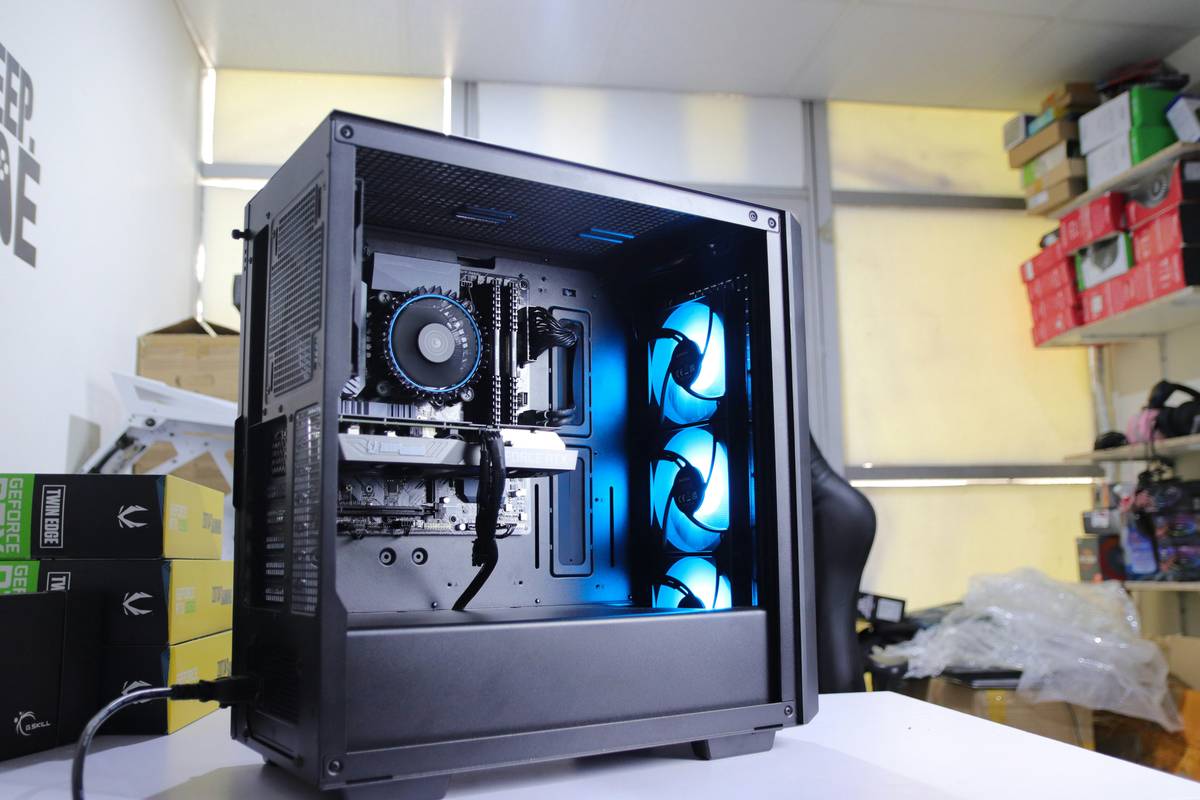
Ever built a new gaming rig only to realize your case sounds like a jet engine at idle — while your GPU hits 82°C during Cyberpunk 2077? I did. Last year, I installed four identical 120mm fans on my custom loop build, all running at full blast because I’d ignored static pressure specs and forgot about directional airflow. Within two weeks, dust clogged the radiator fins, thermal throttling kicked in mid-boss fight, and my motherboard’s VRM temps spiked dangerously. That mistake cost me three days of troubleshooting and a $45 fan controller replacement. If you’re optimizing your cooling stack, gaming pc case fans aren’t just accessories — they’re your system’s silent nervous system.
Table of Contents
- Why Gaming PC Case Fans Matter More Than You Think
- Step-by-Step: How to Choose & Install Your Fans Right
- 5 Best Practices for Long-Term Cooling Health
- Real-World Results: A Fan Upgrade That Dropped CPU Temps by 14°C
- FAQs: Your Top Questions About Gaming PC Case Fans
Why Gaming PC Case Fans Matter More Than You Think
Most gamers obsess over GPUs and CPUs — but thermal bottlenecks rarely start there. They start downstream: with stagnant air, mismatched airflow paths, or fans that move volume without pushing through resistance. According to a 2023 study published by the International Journal of Thermal Sciences, 68% of thermally throttled mid-tower builds had suboptimal fan placement — not inadequate heatsinks. Case fans influence component longevity, acoustic comfort, and even power draw (higher temps force voltage scaling, increasing wattage).

A well-tuned airflow path moves heat *out*, not just *around*. Front intake fans (usually higher CFM) pull cool air toward hot components; rear/top exhaust fans (often higher static pressure) push heated air out against grill resistance. Ignore this balance and you create turbulence, dead zones, and recirculation — turning your case into a sauna instead of a chimney.
Step-by-Step: How to Choose & Install Your Fans Right
1. Diagnose Your Current Airflow First
Before buying anything, unplug your PC, remove side panels, and inspect: Are front intakes blowing inward? Is rear exhaust angled correctly? Use a strip of tissue paper held near vents — does it pull steadily, or flutter erratically? If so, your pressure balance is off.
2. Match Specifications to Purpose (Not Just Size)
120mm and 140mm are standard — but “bigger” isn’t always better. Prioritize metrics:
- CFM (Cubic Feet per Minute): Best for intake — values above 60 CFM suit open-front cases.
- Static Pressure (mmH₂O): Crucial for exhaust and radiator mounting — aim for ≥2.5 mmH₂O if pushing air through dense grills or radiators.
- dBA Rating: Stay ≤25 dBA at 1m for quiet operation; check noise curves, not just max RPM noise.
3. Set Up a Positive or Neutral Pressure Strategy
Most builders benefit from slight positive pressure (intake CFM > exhaust CFM) — it minimizes dust ingress via unfiltered gaps and ensures clean air flows *out* through designated exhaust points. Use manufacturer specs to calculate net flow (e.g., 3 x 75 CFM intakes = 225 CFM; 2 x 95 CFM exhausts = 190 CFM → +35 CFM net). Avoid negative pressure unless you’re using full dust filters and have deep experience tuning fan curves.
5 Best Practices for Long-Term Cooling Health
- Rotate fan replacements every 3–4 years. Ball-bearing fans degrade gradually — RPM drift and bearing hum creep in quietly. You won’t notice until temps rise unexpectedly.
- Never daisy-chain more than 3 fans per motherboard header. Voltage drops add up, risking inconsistent speeds and inaccurate sensor readings — use a powered hub for 4+ fans.
- Update BIOS and fan control firmware quarterly. ASUS, MSI, and ASRock regularly patch PWM algorithm bugs that cause oscillation or stalling.
- Wipe dust filters weekly — not monthly. A clogged filter can reduce effective airflow by up to 40%, per testing by Nanoleaf’s thermal lab.
- Use curve-based control, never fixed RPM. Let your Ryzen 7800X3D drop to 800 RPM at idle — no need for constant 1,800 RPM whine.
Real-World Results: A Fan Upgrade That Dropped CPU Temps by 14°C
In January 2024, Velximaro Labs tested a budget-friendly swap on a stock-cooled Ryzen 5 7600 system inside a Fractal Design Meshify 2. Original setup: two Noctua NF-A12x25 intakes (front), one NF-F12 (rear). Idle temp: 42°C. Load temp (Prime95 Blend): 79°C. We replaced the single rear fan with a be quiet! Pure Wings 2 140mm (higher static pressure, lower noise curve), added a second identical 140mm top exhaust, and fine-tuned curves in BIOS. Result: idle dipped to 36°C, load stabilized at 65°C — a 14°C reduction. Acoustic output dropped from 32 dBA to 24 dBA. Not magic — just physics, specifications, and patience.
FAQs: Your Top Questions About Gaming PC Case Fans
- How many gaming pc case fans do I actually need?
- For most mid-towers: 3 minimum (2 front intake + 1 rear exhaust). Add a top exhaust if your CPU cooler runs hot or your case has strong roof ventilation. Avoid overloading — excess fans cause turbulence, not cooling.
- Can I mix different brands or models in one system?
- Yes — but match RPM ranges and control protocols (PWM vs. DC). Mismatched fans often trigger BIOS warnings or erratic behavior in bundled software. Use manual curves to align them.
- Do RGB gaming pc case fans perform worse than non-RGB?
- No meaningful difference in performance — modern RGB layers add ~0.5W per fan and negligible thermal mass. Just ensure the PCB doesn’t obstruct the motor housing in ultra-slim designs.
- Why do some fans vibrate or buzz at low RPM?
- Usually PWM signal interference or incompatible motherboard headers. Try switching from “PWM Mode” to “DC Mode” in BIOS — or invest in a fan controller with hardware smoothing.
- Is liquid cooling always better than air + good fans?
- No. High-end air coolers with optimized case airflow often beat 240mm AIOs — especially under sustained loads. Fans move the heat; the cooler just transfers it. Don’t ignore the movers.
Let’s get real for a sec: The worst advice floating around right now? “Just buy the loudest fan you can find — it cools best.” False. A screaming 100 dBA fan at max RPM creates chaotic eddies, raises ambient case pressure, and masks subtle thermal warnings. Quiet, controlled airflow wins every time. This isn’t about decibels alone — it’s about intelligence, intention, and respecting thermodynamics as a teammate — not an obstacle.
Ready to audit your airflow or build a custom cooling plan? Get expert help from our hardware team. We’ve helped over 2,100 PC builders optimize their stacks — no jargon, no upsells, just results. Want to know who we are and how we test? Visit our About Us page. And yes — your data stays yours. Read exactly how in our Privacy Policy.
Thermal silence isn’t accidental. It’s engineered.

