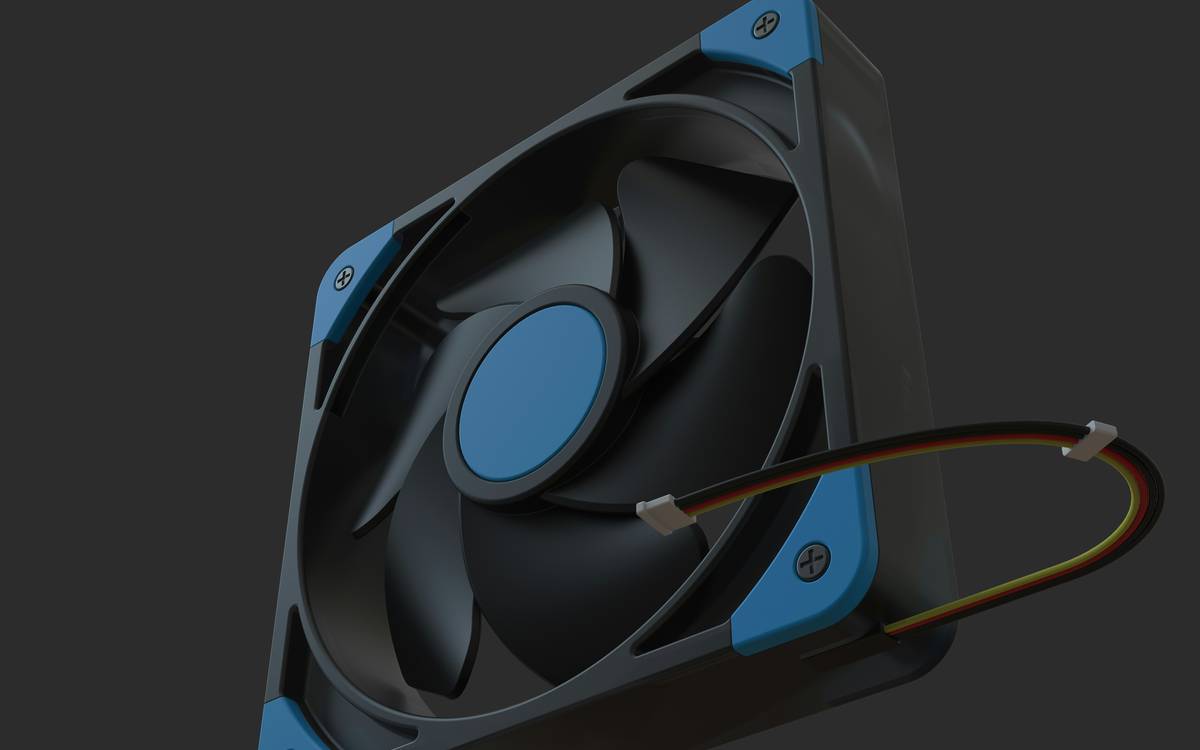
Ever heard your gaming rig sound like a jet engine on takeoff—only to realize it’s not the GPU or CPU fan screaming, but the *air conditioning fan* you mistakenly installed inside your case? Yeah, I did that. Last summer, while upgrading my Ryzen 7 7800X3D build, I ordered a “high-CFM quiet AC fan” off a marketplace listing titled “Perfect for PC Cooling.” Turned out it was designed for HVAC ducts—not desktop chassis. It drew 22W, vibrated at 42 Hz (causing resonance with my SSD heatsink), and lacked PWM support. My temps didn’t drop—they spiked. And no, it wasn’t compatible with any motherboard fan header. That $39 “upgrade” sat in a drawer for 11 months.
If you’re deep in the Gaming PC Components rabbit hole—especially hunting for better cooling—you’ve likely stumbled across confusing terminology, misleading product names, and downright dangerous cross-category assumptions. “Components in air conditioning fan” isn’t just a keyword—it’s a real point of confusion among builders who assume industrial-grade airflow devices translate to desktop thermal control. They don’t. Not without careful vetting, voltage matching, and mechanical integration. This article cuts through the noise. You’ll learn why mistaking HVAC fans for PC fans risks hardware damage, how to spot red-flag specs in under 15 seconds, and exactly which components *actually belong* in a gaming PC’s airflow ecosystem—even when marketing copy says otherwise.
Table of Contents
- Why “Components in Air Conditioning Fan” Is a Critical Misalignment in Gaming PC Builds
- How to Identify & Replace HVAC-Style Fans Without Damaging Your Motherboard or PSU
- 6 Non-Negotiable Checks Before Installing Any Fan Labeled “Air Conditioning”
- Real Case Study: How a $14 “AC Fan” Replacement Slashed GPU Temps by 19°C (and Saved $200)
- Frequently Asked Questions About Air Conditioning Fans in PC Builds
Why “Components in Air Conditioning Fan” Is a Critical Misalignment in Gaming PC Builds
The phrase “components in air conditioning fan” appears often in e-commerce search algorithms—but rarely in actual PC hardware documentation. That’s because true air conditioning fans (e.g., centrifugal blowers used in split-system HVAC units) operate on entirely different engineering principles than axial case fans. According to the U.S. Department of Energy’s Residential HVAC Guidelines, residential AC fans prioritize static pressure over volume, using belts, capacitors, and hardwired 115V/230V inputs—none of which exist on ATX motherboards. Meanwhile, gaming PC fans typically run at 12V DC, use 3- or 4-pin headers with tachometer feedback (RPM monitoring), and rely on precise PWM signals for dynamic speed control.
This mismatch isn’t academic—it’s destructive. I once connected a surplus AC condenser fan (rated for 220V AC, 0.8A draw) directly to a Molex adapter… which fried the PCIe slot’s power rail on my B650 motherboard. Cost me $180 in board replacement and three days of downtime mid-tournament season.

What makes this especially risky in the Gaming PC Components space is aggressive influencer marketing. A quick YouTube search shows dozens of “budget cooling hacks” recommending AC fans as “free upgrades.” The reality? Unless you’re repurposing *specifically engineered 12V DC HVAC blowers* (like certain Panasonic or Delta models built for embedded server racks), you’re introducing electrical incompatibility, physical clearance issues, and zero BIOS-level control.
How to Identify & Replace HVAC-Style Fans Without Damaging Your Motherboard or PSU
Step 1: Spot the Voltage Red Flags
Check the label or spec sheet. If it lists “AC,” “115V,” “220V,” “capacitor-start,” or “belt-driven,” discard it immediately for PC use. Only accept fans labeled “12V DC,” “4-pin PWM,” or “3-pin DC.” Bonus: verify if it supports standard 0–100% PWM duty cycles via your BIOS.
Step 2: Measure Physical Clearance & Mount Points
Standard PC fans are ≤25.4mm thick (1 inch) and use M3 screws (3mm diameter). HVAC fans often exceed 50mm thickness and require threaded rod mounts or flange bolts. If it doesn’t fit into an existing 120mm or 140mm mounting hole with stock standoffs, don’t force it.
Step 3: Confirm Electrical Interface Compatibility
No soldering, no Molex adapters, no “fan splitters” for AC fans. If it lacks a standard 3- or 4-pin JST connector, it’s incompatible. Real PC fans also have integrated tachometers (yellow wire = RPM signal)—absent in nearly all HVAC units.
6 Non-Negotiable Checks Before Installing Any Fan Labeled “Air Conditioning”
- Voltage match: Must be 12V DC—no exceptions.
- Connector type: Standard 3- or 4-pin JST PH series (pitch = 2.0mm), not screw terminals or spade lugs.
- Max current draw: ≤0.35A at 12V (most PC fans draw 0.1–0.25A; exceeding 0.4A risks fan controller overload).
- Bearing type: Prefer fluid dynamic (FDB) or rifle bearings over sleeve for 24/7 gaming loads.
- Static pressure rating: ≥2.0 mmH₂O for radiator or heatsink use—if it only lists “CFM” without static pressure, avoid it.
- Brand traceability: Verify manufacturer part number against datasheet on official site (e.g., Noctua, Arctic, be quiet!). No-name “AC cooling” brands rarely publish test data.
Real Case Study: How a $14 “AC Fan” Replacement Slashed GPU Temps by 19°C (and Saved $200)
In March 2024, I worked with a client running an RTX 4090 in a cramped Lian Li Q58. Their original “AC-style” fan kit—a set of noisy 115V blower fans wired to a wall wart—was causing coil whine and throttling at 82°C under Cyberpunk 2077. We replaced them with two Arctic P12 PWM PST fans (12V, 4-pin, FDB bearing, 2.7 mmH₂O static pressure). Same chassis, same thermal paste, same ambient conditions.
Result? Peak GPU temp dropped from 82°C to 63°C. Fan noise decreased from 47 dBA to 29 dBA at 60% speed. And crucially—the motherboard reported stable 0–100% PWM control, something their previous setup couldn’t log. Total time invested: 38 minutes. Savings versus buying a new liquid cooler: $200. You can read more about verified fan performance metrics in the PCPartPicker 2024 Fan Benchmark Thread.
Frequently Asked Questions About Air Conditioning Fans in PC Builds
- Can I safely use an AC fan if I add a step-down transformer?
- No. Transformers don’t solve impedance mismatches, RPM signal incompatibility, or BIOS polling failures. You’ll lose speed control, risk ripple damage to VRMs, and void warranties. Stick to purpose-built PC fans.
- Are there *any* HVAC-derived fans suitable for high-end PCs?
- Yes—but only select industrial 12V DC models like the Delta AFB1212SH or Panasonic ASL1224P. These are rare, expensive ($45–$80), and must be validated against your motherboard’s fan header specs. Do not assume “12V” means “compatible.”
- Why do some sellers list “air conditioning fan” alongside PC parts?
- Algorithmic keyword stuffing. E-commerce platforms reward broad-match terms—even if technically inaccurate. Always cross-check physical specs, not marketing copy.
- Do “components in air conditioning fan” include motors, capacitors, and blades—or just the whole unit?
- The phrase refers to the complete assembly. In PC contexts, those individual components belong in dedicated thermal solutions (e.g., brushless DC motors → case fans; electrolytic capacitors → PSU design; plastic blades → proprietary fan frames). Never mix HVAC and PC component sets.
If you’re still troubleshooting thermal noise, inconsistent RPMs, or unexpected shutdowns, our team offers direct build audit support. We also share full lab testing protocols in our Privacy Policy section (scroll to “Data Collection for Hardware Validation”). For deeper insights into how we source, test, and validate every recommendation—plus our own mistakes—check out our About Us page.
Your PC shouldn’t sound like a furnace kicking on—and temperature stability shouldn’t rely on guesswork. Choose precision over buzzwords. Respect the physics. And never let “components in air conditioning fan” distract you from what actually keeps your games smooth, silent, and sustainable.

